
Section 1: The Harsh Reality of Applicant Tracking Systems (ATS)
Direct Answer: An Applicant Tracking System (ATS) is software employers use to parse resumes, extract hard-skill terms, and rank candidates against a job description before a human recruiter reviews applicants.
Whether you are a college senior entering the workforce or an experienced executive, the “black hole” of job applications is real. You apply, and then silence. No interview. No rejection email. Just nothing.
The reason is often technical, not about your skills, experience, or fit for the role.
Before a human recruiter ever evaluates your skills, your resume must survive the Applicant Tracking System (ATS). The ATS is the gatekeeper. And contrary to what some might claim, the “Robot Overlord” is not a myth—it is a strict digital bouncer that rejects qualified candidates every single day simply because their resume formatting confused the software.
Key Takeaways
- ATS rejects many qualified resumes due to formatting and keyword misalignment, rather than a lack of qualifications.
- The “Keyword Gap” is a primary reason qualified candidates fail initial screening.
- Use our free AI prompt (below) to audit your resume in 60 seconds.
Parsing: The Invisible Barrier
The ATS is a digital filing cabinet, but it does not simply store your resume; it must first parse it. Parsing (extract, recognize, read, map to internal fields, score) is the part of the ATS software that attempts to import the text from your Microsoft Word or PDF document and organize it into the recruiter’s digital database fields (e.g., Name, Education, Experience, Skills).
If your resume uses “creative” formatting to control the visual layout, the parser will likely fail. It cannot translate elaborate design into data. When the parser fails, your profile ends up incomplete or garbled, and you are effectively invisible to the ATS scoring stage and the human job recruiter.
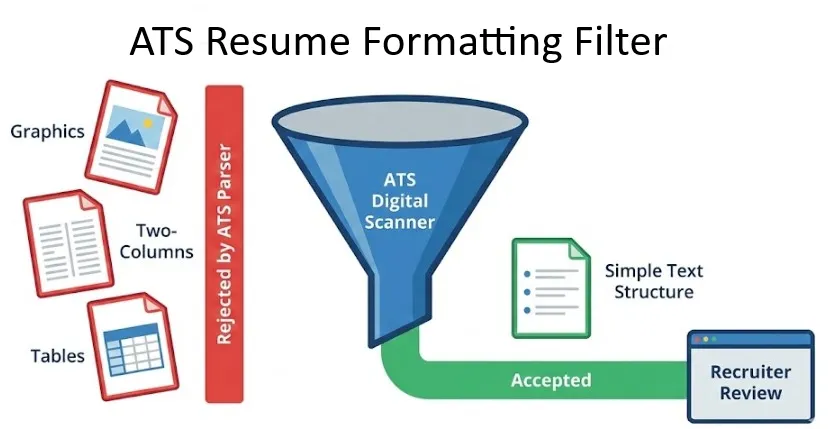
Bad ATS Formatting Errors to Avoid:
If your resume contains any of the following, you are at high risk of being filtered out by the parsing software:
- Headers & Footers: (Contact info placed here is often unreadable).
- Two-Column Layouts: (Parsers often read straight across, scrambling your work history).
- Text Boxes & Shapes: (The text inside is frequently invisible to the software).
- Tables: (Grid lines confuse the reading order).
- Graphics, Icons, & Logos: (These jam the parser).
- SmartArt & Charts: (Unreadable).
- Symbols: (Stick to standard bullets; avoid arrows, checkmarks, or Wingdings).
- Hidden Text or White Font.
- Image-based PDFs: (PDFs created from scanned Word documents are unreadable images; standard Word documents exported directly to PDF are acceptable, though Word .docx is safest).
Good/Safe Formatting: What the ATS Can Read
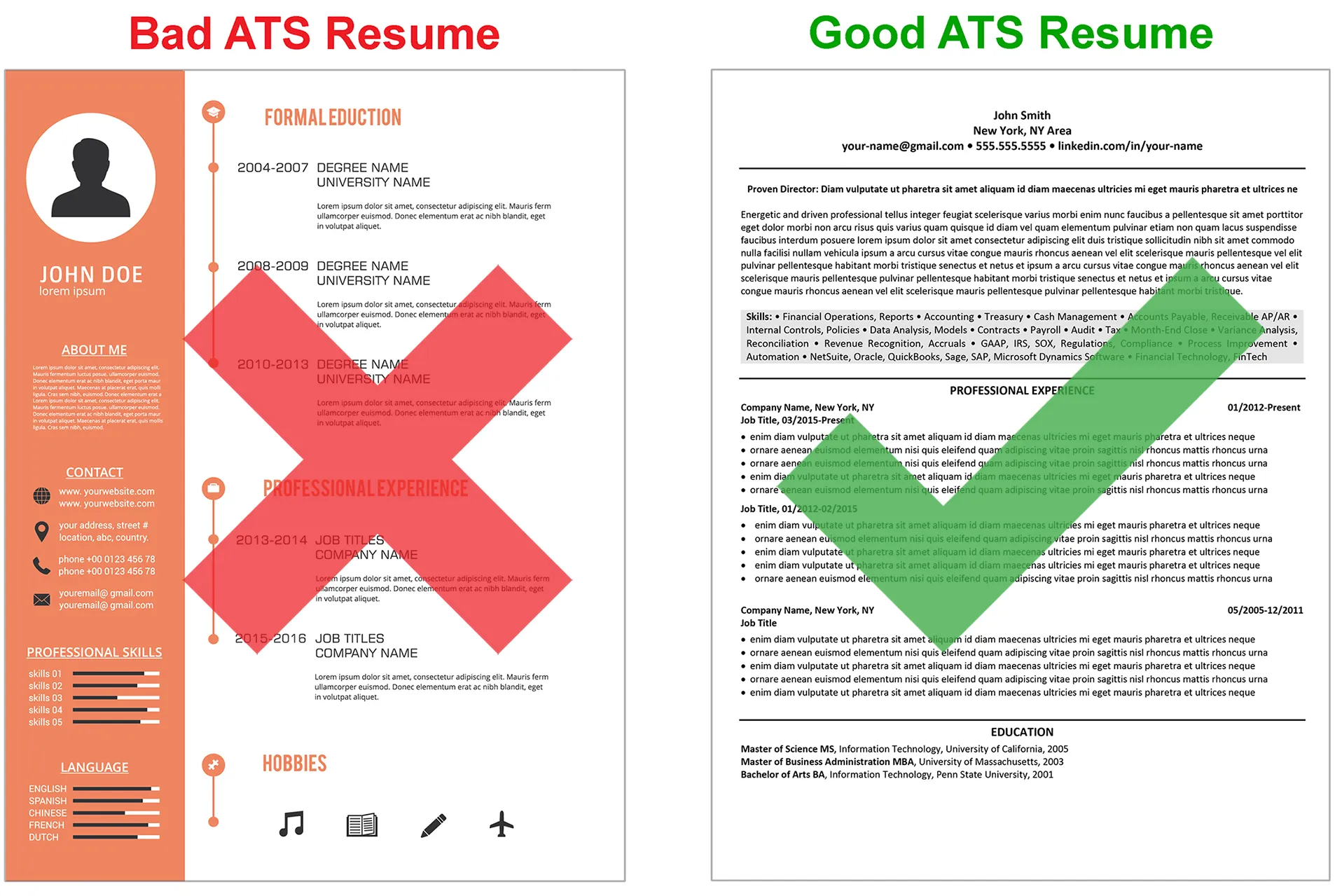
To ensure your resume parses correctly, you must prioritize text structure over design. Use the following Microsoft Word standards:
- Headings: Standard bold text for headings and titles.
- Font Color: Black or blue only.
- Bullets: Standard round bullet points.
- Font Family: Calibri (or similar standard sans-serif).
- Hierarchy: Consistent font sizes (e.g., 10.5, 11, 12).
- Alignment: Left-aligned text.
- Spacing: Simple paragraph spacing.
- Section Headers: Plain text, 12 point.
- Capitalization: Standard capitalization (avoid All Caps).
- Dates: Numeric format (MM/YEAR).
- Ranges: Standard hyphens or en dashes.
- Emphasis: Basic italics only.
- Layout: Single-column, standard margins, normal line spacing.
The “Legacy” Problem
While some cutting-edge tech companies have advanced scanners, the vast majority of employers—from mid-sized firms to Fortune 500 giants—rely on older or standard versions of systems like Taleo, iCIMS, or BrassRing. These systems are notoriously rigid. They do not forgive formatting errors.
Ranking: The Second Hurdle
Once your resume survives the parse, it faces the Ranking Algorithm.
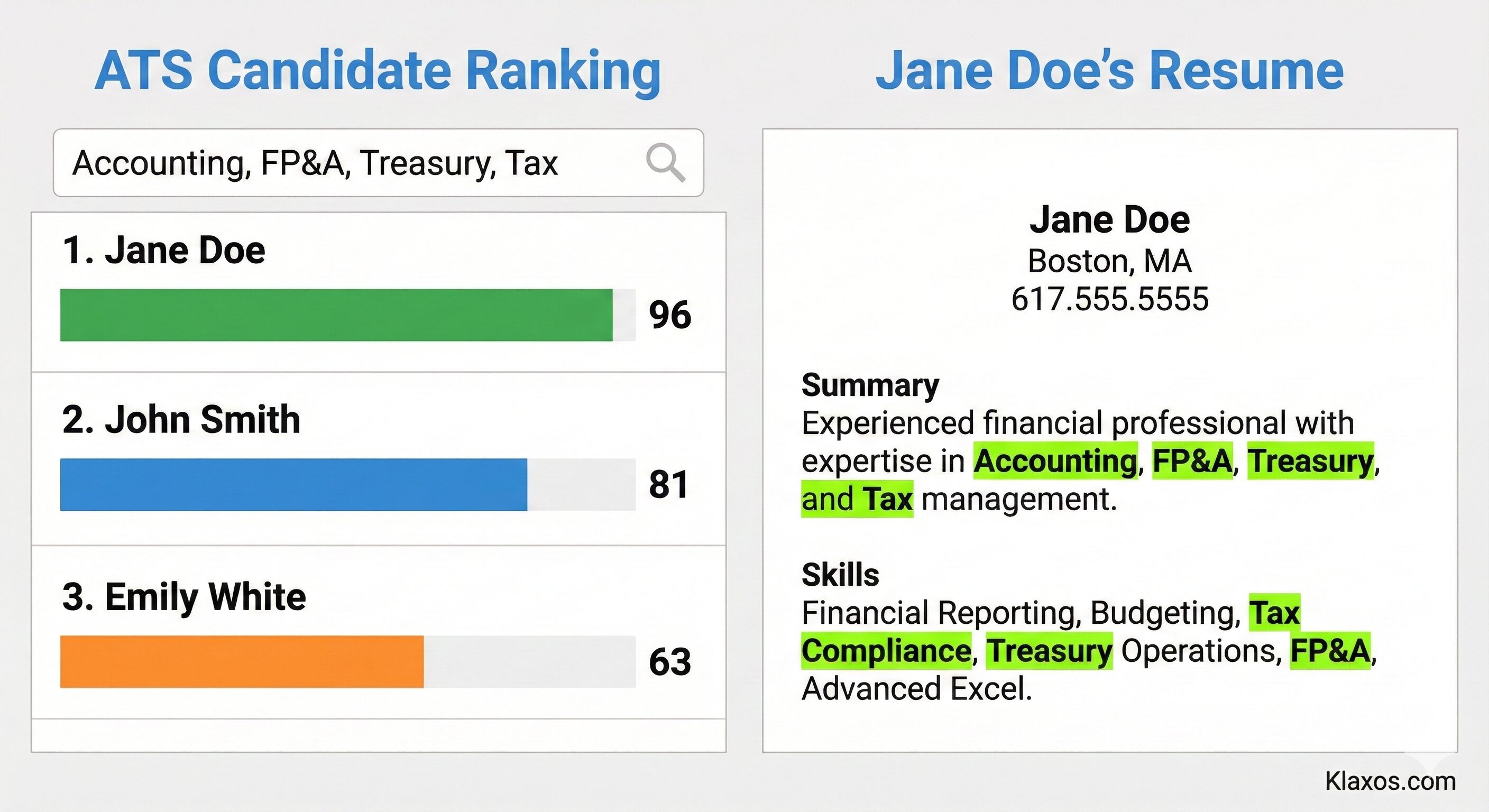
When you apply for a Senior Manager of Supply Chain role, the recruiter might receive 400 applications. They cannot read 400 resumes. They ask the system to rank them.
The system scans for “Ranking Signals”—specifically, Hard Skills and Job Scope keywords.
- What matters: Specifics. Terms like P&L Management, SAP Implementation, revenue growth, Cross-Border M&A, Six Sigma Black Belt.
- The Consequence: If the job description demands “Global Logistics” and your resume only says “Shipping,” you will rank below other candidates who explicitly list “Global Logistics.” The recruiter typically only reviews the top 20–30 matches.
The goal of an optimized résumé is not just qualification; it is readability and ranking high enough to earn a full review by a recruiter. You must pass the ATS formatting gate and rank well for keywords to reach a human decision-maker.
“`html
The image below shows how format and design determine whether an ATS can read your resume.
Section 2: The “Keyword Gap” (Why Qualified Candidates Rank Low)
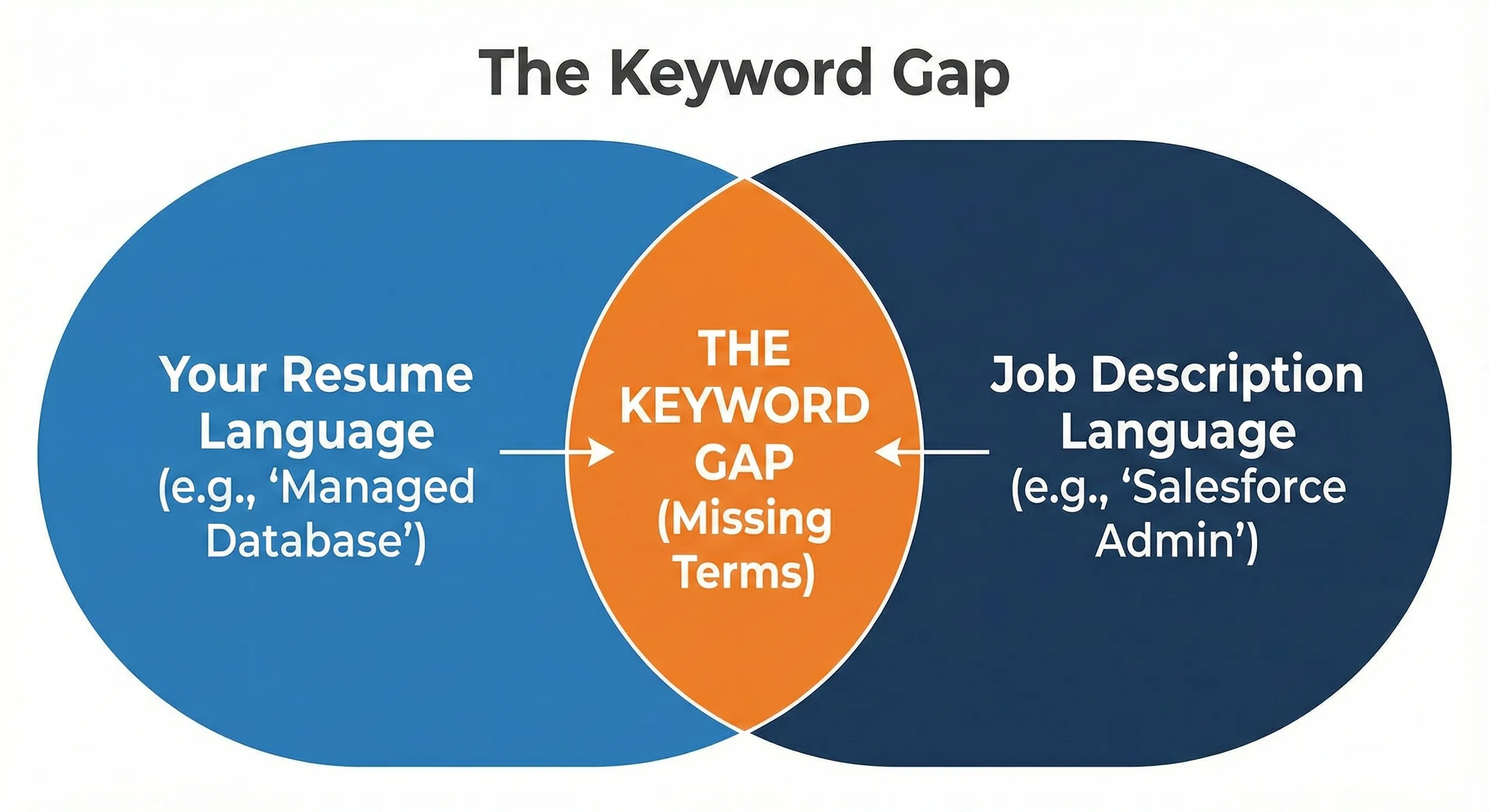
Once your resume passes the formatting gatekeeper, it is sent to the scoring engine. This is where most qualified candidates fail. They fail not because they lack experience, but because they have a Keyword Gap.
The Keyword Gap is the disconnect between the language you use to describe your career and the specific terminology the employer (and the ATS) is hunting for.
Hard Skills vs. Soft Skills: What Actually Counts
To an ATS, not all words are equal. The algorithm weighs Hard Skills and Job Scope heavily while largely ignoring Soft Skills.
Soft Skills (Less emphasis by ATS)
Recruiters give less weight to subjective traits in their search at this stage because they first need evidence that a candidate can do the job: required systems, functional expertise, industry knowledge, and measurable outcomes. Hard skills act as a fast qualification filter. Without them, the résumé is screened out regardless of soft-skill claims. Words like collaborative, adaptable, leader, visionary, critical thinking, problem-solving, or thought leader are less important at this stage. They occupy valuable real estate on your resume but are unlikely to increase your ranking score.
While raw parsing and ranking weigh hard terms heavily, strategic positioning of a contextual career narrative still matters for human search queries in ATS. Soft skills are critical to securing a job offer, but their impact occurs during verbal interviews, not during résumé screening by an ATS or a human reviewer.
Hard Skills (Ranked by ATS)
The system is programmed to find concrete, verifiable evidence of your ability to do the job. It looks for matches in these specific categories:
- Function: Sales, Accounting, Tech Roadmapping, Network Operations, Marketing, P&L Management, M&A Integration, Supply Chain, Government Relations.
- Methodologies: Agile, Six Sigma, GAAP, SPIN Selling.
- Software/Tools: Salesforce, SAP, Python, Tableau, Oracle ERP.
- Certifications: PMP, CPA, RN, MBA, SAFe, Security+, SHRM-CP.
The “Synonym” Trap
A common mistake is assuming the ATS is smart enough to understand synonyms. While AI is improving, many legacy systems are literal.
- You wrote: “Managed customer database.”
- The job description wants: “Salesforce CRM Administrator.”
- The result: You might be the best customer database manager in the world, but if the system is scoring for “Salesforce,” you earn zero points for that keyword.
Legacy systems remain literal, but some newer ATS have AI components that may capture semantically related terms. When in doubt, include both exact wording and well-crafted context to increase relevance without keyword stuffing.
The Solution: Alignment, Not Copying
Do not copy all or numerous lines of text from the entire job description and paste them into your resume (a tactic called “white fonting,” which gets your resume rejected). However, you must close the gap on critical hard skills. If the job description mentions “Strategic Planning” five times and you call it “Business Strategy,” you are taking an unnecessary risk.
To rank among the best applicants, you must identify exactly which hard skills the ATS is prioritizing and ensure they appear explicitly in your resume’s Headline, Summary, Job Scope, Achievements, Education, or Skills section.
How Modern AI-Enhanced ATS Actually Work (2026 Reality)
Some modern ATS no longer rely solely on literal keyword matching. Newer platforms apply AI-driven semantic analysis that interprets context, related terms, and how skills are expressed across sentences. Recruiters may use semantic ranking features to surface candidates whose experience aligns conceptually with the role, even when wording differs. Exact keywords still matter for baseline ranking, but clarity is essential. Strong resumes connect responsibilities, tools, and outcomes in precise narrative sentences. Strategic synonym use—paired with industry-recognized job titles and hard-skill language—boosts relevance without keyword stuffing.
Section 3: How to Optimize Your Resume for ATS Using Free AI Tools
You do not need to pay monthly subscription fees for tools like Jobscan to see how your resume stacks up against a job description. You can use free AI tools like Google’s Gemini to perform the same “gap analysis” in less than 60 seconds.
The goal isn’t to get a 100% match or add fluff like “team player.” The goal is to find the critical hard skills and specific terminology the applicant tracking system (ATS) is searching for, which you might have accidentally left out.
Step 1: The Setup
Open your preferred AI tool (e.g., Gemini, ChatGPT, Claude, Grok, etc.) and copy/paste the prompt below.
Step 2: The Prompt
Copy the text below and paste it into your preferred AI chat box. Then, upload or paste your resume text and the job description text where indicated at the bottom of the prompt.
Act as an expert Applicant Tracking System (ATS) algorithm. I am providing you with my resume and my target Job description. Your goal is to identify the “Keyword Gap”—the specific hard skills, software, methodologies, and technical job scope phrases that appear in the Job description but are missing from my resume.
Rules for your analysis:
- Focus ONLY on “Hard” Ranking Factors: Look for technical skills, specific software names, industry-standard methodologies, certifications, and hard functional areas (e.g., “P&L management,” “SaaS sales,” “Python,” “GAAP,” “Supply Chain Optimization”).
- Ignore “Soft” Skills: Do not suggest generic traits like “communication,” “leadership,” “collaborative,” or “motivated.” These do not significantly impact ATS ranking.
- Be Specific: Do not say I am missing “Sales skills.” Tell me if I am missing “Challenger Sales Model” or “Salesforce CRM.”
- Output: Provide a list of up to 10 missing keywords or phrases, in ranked order, that are most likely to hurt my ranking if omitted.
My Resume:
[PASTE YOUR RESUME TEXT HERE OR UPLOAD IT AS AN ATTACHMENT]
Job Description:
[PASTE TARGET JOB DESCRIPTION HERE OR UPLOAD IT AS AN ATTACHMENT]
Step 3: How to Edit Your Resume
Once the AI tool generates the list, look at the missing keywords or phrases. If you actually possess these skills or have this experience, add them to your resume immediately.
Where to put them:
- Job Scope: If you missed a phrase describing the type of work (e.g., “High-volume manufacturing”), add it to the introductory paragraph of your relevant job entry.
- Achievements: If the keyword is a specific outcome or method (e.g., “Kaizen”), weave it into a “Select Achievement” bullet (e.g., “Reduced waste by 15% using Kaizen methodologies…”).
- Skills Section: If it is a software or hard certification (e.g., “Tableau,” “PMP”), add it to your “Core Competencies” or “Technical Skills” section at the bottom or top of the resume.
Be honest. If you don’t have the skill, don’t add the keyword. But if you do have it and it’s called something else (e.g., you wrote “CRM” but they want “Salesforce”), change your wording to match theirs exactly.
Section 4: The Limitations of AI (Why You Still Need a Human Strategy)
Using AI to identify missing keywords is a useful tactic because it addresses the technical ranking requirement. However, keyword optimization alone is only a small part of résumé effectiveness and cannot compensate for a résumé that fails to convey relevant scope, achievements, and hard skills clearly.
Once your resume passes the ATS and lands on a recruiter’s screen, the algorithm stops mattering. Now, a human being is reading it. And humans do not hire lists of keywords; they hire the candidate with the most compelling combination of hard skills, soft skills, functional competence, and proven achievements.
AI Can Count, But It Cannot Persuade
AI tools like Gemini and ChatGPT are excellent at data matching, but they struggle with narrative.
- AI writes: “Responsible for leading a team to improve sales processes.” (Accurate, but not impactful).
- A Human Resume Writer at Klaxos writes:“Drove 22% YoY revenue growth in a stagnant market by leading a sales turnaround through decisive improvements to people, processes, and tools.”(Leads with the result. Adds how the turnaround happened in a compelling and specific way).
Reliance on AI often leads to resumes that sound robotic. If every candidate uses ChatGPT to write their summary, they all sound the same—generic and forgettable.
For experienced professionals and executives, your value proposition is unique. It requires nuance. It requires explaining why you made a strategic pivot, how you navigated a crisis, or what your leadership philosophy looks like in practice. No algorithm can extract that story from your head.
The Winning Formula: Human Strategy First, AI Audit Second
The smartest candidates use a hybrid approach:
- Use a Certified Professional Resume Writer (e.g., Klaxos) to craft the narrative, structure the arguments, and ensure the document is visually and psychologically compelling to both the ATS parsing software and the human reader.
- Use AI to audit your keywords and scope to ensure the ATS isn’t unfairly filtering you out.
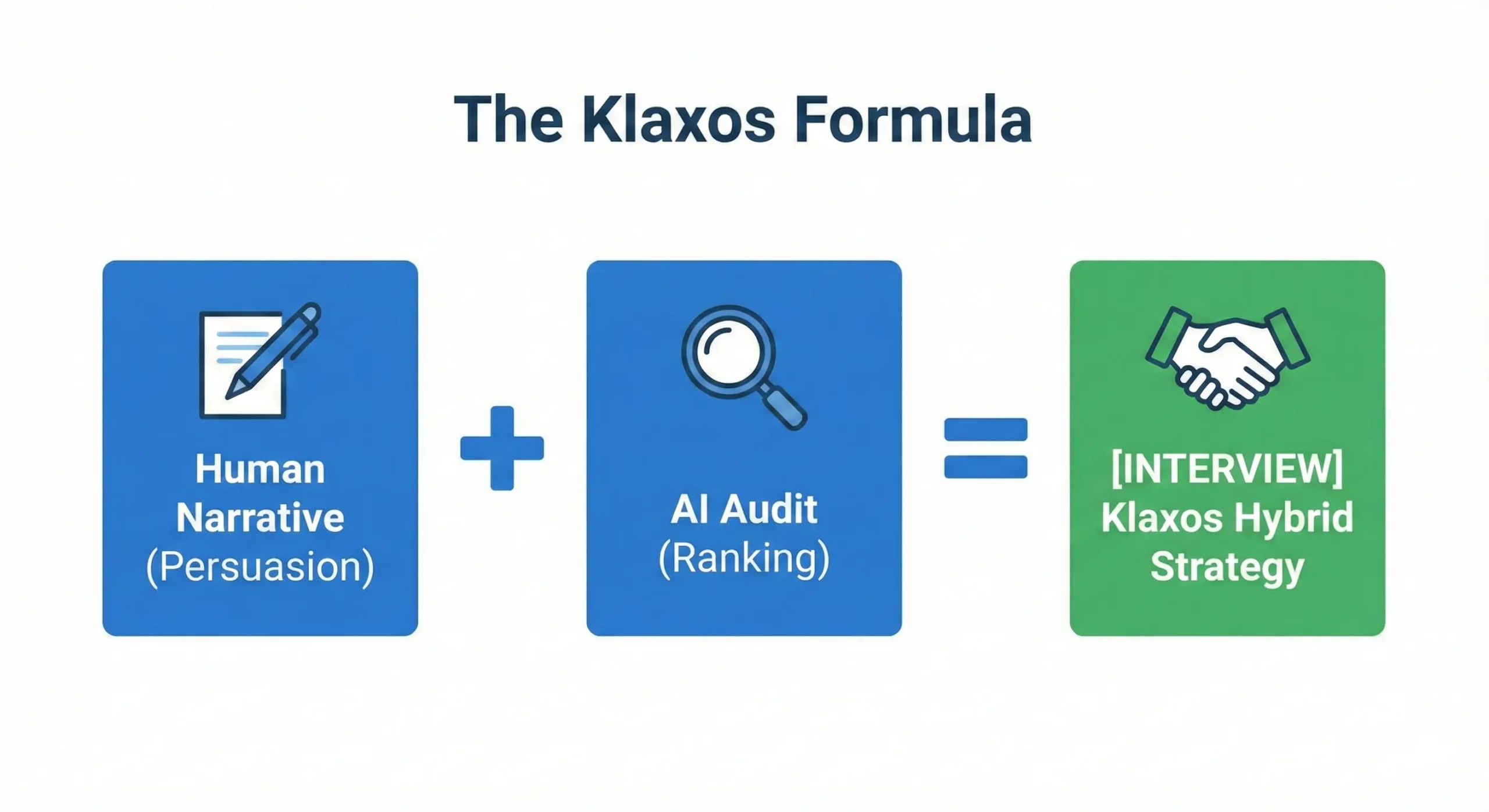
At Klaxos, we are leaders in this dual approach. We write resumes that deliver the high-impact narrative that top job recruiters demand while satisfying the strict technical requirements of modern Applicant Tracking Systems.
We have helped 6,000+ professionals and executives secure top roles faster by crafting personalized, high-impact résumés and LinkedIn profiles designed to generate more interviews.
Our services also include access to proprietary job-search resources: targeted emailing to recruiters from our database of approximately 40,000 U.S. executive recruiters, used selectively to expand visibility and accelerate momentum.